Publications
De Franco, C. & Gelot, L. (2026). Unleashing and Taming Violent Peacekeepers: Civilian Harm Mitigation in Peace Operations. Journal of Intervention and Statebuilding, 1–24.
This article examines how violence is reconfigured in contemporary peace operations through the rise of civilian harm mitigation as a distinct mode of governance. Drawing on the concept of global security assemblages, it traces how civilian harm mitigation emerges from shifting alignments and frictions among mission leaderships, troop-contributing countries, NGOs, legal experts, donors, and local communities. It shows how civilian harm mitigation recasts the boundaries of acceptable military conduct in peace operations, revealing violence as a malleable construct shaped by competing rationalities, interests, and power relations, and by evolving commitments to counterinsurgency and international law.
Alin Hilowle Hassan, Adan Mohamed Yusuf, Chiara De Franco, and Linnéa Gelot (2025), “Community Perspectives on Conflict-Related Harm Mitigation,” Odense: PROTEX Project, Center for War Studies.
This report presents findings from a pilot research collaboration between the PROTEX Project and the Isha Human Rights Organization (IHRO) on community perspectives on conflict-related harm in Southwest Somalia. Based on field research conducted by IHRO in Baidoa and surrounding districts, the report highlights how harm is experienced cumulatively across physical, psychological, social, and economic dimensions, and how documentation remains fragmented, informal, and often invisible to external actors.
De Franco, C. & Gelot, L. (2025). A Bourdieusian Perspective on Contestation Theory, in Sassan Gholiagha, Phil Orchard, and Antje Wiener (eds), The Oxford Handbook of Norms Research in International Relations, Oxford Handbooks, 480-490.
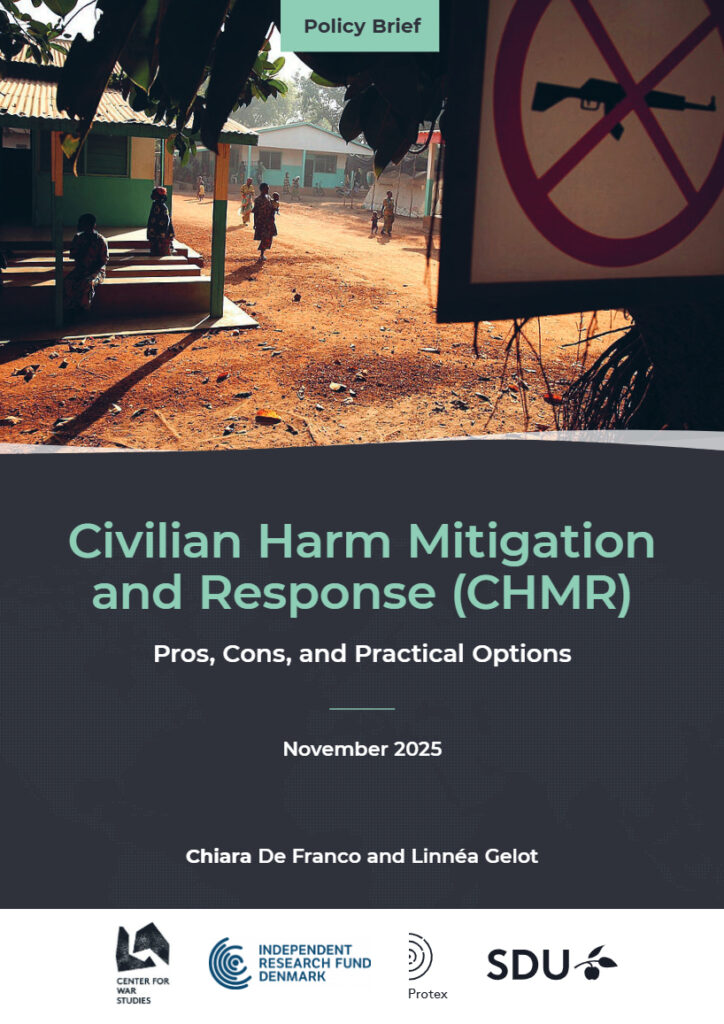
Chiara De Franco & Linnéa Gelot (2025). Civilian Harm Mitigation and Response (CHMR): Pros, Cons, and Practical Options, Odense: PROTEX Project, Center for War Studies.
This policy brief distils key insights from the PROTEX project’s research and the expert workshop Civilian Harm Mitigation and Response (CHMR) and the Future of Human Protection held in Brussels in September 2025. It identifies emerging challenges and actionable pathways for strengthening CHMR and offers evidence-based recommendations aimed at enhancing institutional readiness, improving cross-organisational cooperation, and supporting more responsible and accountable responses to civilian harm in complex conflict environments.
De Franco, C., & Gelot, L. (2025). Right(s) practice: normative competence negotiation in the struggles over human rights protection in AMISOM. Journal of International Relations and Development.
This article examines the interplay of power and norm contestation in the AU–EU strategic partnership, focusing on struggles over human rights protection in the African Union Mission in Somalia (AMISOM). While AMISOM marked a milestone for African-led conflict management, reports of civilian casualty triggered EU concerns over compliance with human rights and international humanitarian law. In response, AU officials promoted an African-led approach to civilian protection, seeking recognition for their human rights competence. To make sense of these dynamics, we employ a Bourdieusian framework and introduce the notion of “normative competence negotiation,” defined as the dynamic recognition of agents’ ability to call and act out appropriate conduct in a field of practice. Drawing
on fieldwork (2016–2024) in Baidoa, Mogadishu, Addis Ababa, Brussels, Nairobi, and remotely, we analyse how AU and EU actors negotiated normative competence through the implementation of the Civilian Casualty Tracking, Analysis, and Response Cell (CCTARC). We show how AU’s competence claims challenged the EU and partially reshaped field dynamics, though structural asymmetries persisted. The article contributes to contestation theories by foregrounding power as emerging from contestation, advances Bourdieusian IR by theorizing norms as symbolic capital, and develops a practice-theoretical account of normative competence as relational and field-dependent.
De Franco, C., Zhang, Q., Noach, O., & Nadibaidze, A. (2025). WarPod #9: The Future of Human Protection.
The WarPod speaks to Chiara De Franco (Associate Professor at the CWS and Principal Investigator of the PROTEX project), Qiaochu Zhang (Postdoctoral Researcher at the CWS), and Oscar Noach (PhD Fellow at the CWS) about the future of human protection in international relations. This episode is based on discussions held at the conference “The Future of Human Protection” held in Copenhagen in January 2025.
Rose, S. (2024). Locating the stigmatisation of children born of wartime rape on a continuum of violence. The International Journal of Human Rights, 29(3), 1–25.
Children born of wartime sexual violence remain a marginalised group whose lives and needs have largely been overlooked. Over the past two decades, scholarship has emerged addressing some of the multiple issues they face. This research shows that stigmatisation is central in the children’s lives, but rarely provides a deeper definition of stigma that interrogates its structural and political dimension. Bridging feminist peace scholarship and new streams of stigma research, this article sets out to conceptualise stigmatisation as a complex form of violence that concurrently reflects and reproduces gendered power dynamics across the peace–war spectrum. Drawing on narratives by children born of war in the Central African Republic, Uganda, and Bosnia-Herzegovina, this article examines how stigmatisation materialises as different forms of ‘everyday violence’ that intersects at a personal, social, and structural level. By untangling their stories, the study shows how stigmatisation profoundly impacts the children’s experiences of peace and sustains the ‘conditions of war’ in the everyday space while perpetuating structural cycles of gender-based violence that persists in transitional and post-conflict environments. The article highlights the importance of placing the children’s perspectives at the centre when analysing stigmatisation and offers new insight on how stigma operates as violence.
De Franco, C. (2024). Languaging in Social Practices: The Role of Narrative Games in Shaping Diplomatic Conventions. Linguistic Frontiers, 7(1).
This article examines the role of languaging in shaping social practices, drawing on Maturana’s concept of consensual coordination. It posits that social practices are essentially enlanguaged activities, emerging and evolving through the conventions born from recursive interactions. Central to this argument is a reinterpretation of Maturana’s typology of conversations, suggesting it as a guide to the kinds of conventions that can emerge from consensual coordination. The article introduces an analytical framework conceptualizing narrative games as languaging mechanisms. This framework is informed by an abductive process based on radical linguistics and the analysis of 128 diplomatic conversation transcripts. In its conclusion, the article offers insights into how languaging plays a crucial role in establishing conventions and rules within social practices. It also examines the capacity of languaging to drive social change, underscoring the importance of future research in this area.
De Franco, C., & Moe, L. W. (2024). Assembling intelligence in United Nations peacekeeping: between transformation and path dependency. International Affairs (London), 100(3), 1043–1066.
This article traces the evolution of intelligence in United Nations peacekeeping through a practice-based assemblage lens. We address a gap in the literature by transcending the focus on ‘peacekeeping intelligence’ as merely an evolving policy instrument. Instead, we employ an ‘analytic of assemblage’ that reveals the intrinsic ambiguity of both the concept of peacekeeping intelligence, and the related competing perspectives as well as forms of expertise among stakeholders. We select the United Nations Operation in the Congo (ONUC, 1960–1964), the United Nations Stabilization Mission in Haiti (MINUSTAH, 2004–2017), and the United Nations Multidimensional Integrated Stabilization Mission in Mali (MINUSMA, 2013–2023) as cases to reconstruct the historical evolution of intelligence within peacekeeping. Our analysis reveals profound tensions between efforts to transform intelligence for broader goals like the protection of civilians, on the one hand, and the persistent dominance of military knowledge and tactical priorities in its implementation, on the other. We convey the enduring predominance of military priorities shaping intelligence practices across spatio-temporal contexts, grounded in historical legacies of doctrinal developments, training and regional collaborations. The analysis thereby highlights the interplay between contingency and the influence of enduring power structures in shaping the evolving peacekeeping assemblage. This offers a perspective that links assemblage approaches with the analysis of not only emergence but also path dependency influenced by historical and geopolitical contexts and suggests that strengthening such analytical link holds wider potential for advancing contributions of assemblage approaches to critical security studies.
De Franco, C. (2023). Connecting the Local and the Global: International Practice Theory as a Trading Zone for International Relations and Area Studies Scholars. In: D’Amato, S., Dian, M., Russo, A. (eds) International Relations and Area Studies (pp. 93–109). Springer International Publishing AG.
International Practice Theory (IPT) has established a new paradigm that puts practitioners’ quotidian doings front and centre of International Relations (IR) theorising. It is proving to be an influential development also for Area Studies (AS) that share much of IR’s scholarship and objects of study. This is certainly the case for European Studies (ES) as the works of IPT scholars have raised attention to situated, mundane and everyday practices of EU institutions. This chapter reviews the contribution of IPT scholars to ES to assess the added value of this research agenda and its potential to become a “trading zone” where IR and AS scholars can advance their understanding of how the local and the global connect. It also identifies two challenges that have not been adequately addressed in the extant literature: (1) finding ways to theorise and empirically observe the transition from situated to global practices (generalisation challenge); and (2) assessing the exact role of interaction in structuring and transforming both the global and the local (challenge of relationism). The chapter ends by calling for a Global Practice Theory (GPT) as a way to tackle these two challenges.
Duursma, A., Bara, C., Wilén, N., Hellmüller, S., Karlsrud, J., Oksamytna, K., Bruker, J., Campbell, S., Cusimano, S., Donati, M., Dorussen, H., Druet, D., Geier, V., Epiney, M., Gelot, L., Gyllensporre, D., Hiensch, A., Hultman, L., Hunt, C. T., … Wenger, A. (2023). UN Peacekeeping at 75: Achievements, Challenges, and Prospects. International Peacekeeping (London, England), 30(4), 415–476.
This year marks the 75th anniversary of what the UN itself understands to be its first peacekeeping operation. It is therefore an appropriate time to reflect on the track record of UN peacekeeping in its efforts to try to maintain and realize peace and security. Moreover, this milestone invites us to ponder what lies ahead in the realm of peacekeeping. For this reason, this forum article brings together both academics and UN officials to assess the achievements and challenges of UN peacekeeping over the past 75 years. Through a dialogue among peacekeeping scholars and practitioners, we hope to identify current trends and developments in UN peacekeeping, as well as explore priorities for the future to improve the effectiveness of peacekeeping operations in terms of achieving their mandate objectives, such as maintaining peace, protecting civilians, promoting human rights, and facilitating reconciliation. This forum article is structured into six thematic sections, each shedding light on various aspects of UN peacekeeping: (1) foundational principles of UN peacekeeping – namely, consent, impartiality, and the (non-)use of force; (2) protection of civilians; (3) the primacy of politics; (4) early warning; (5) cooperation with regional organizations; and (6) the changing geopolitical landscape in which UN peacekeeping operates.
Rose, S. (2023). Stigma, Gender, and Violence: Rethinking the Stigmatization of Survivors of Wartime Abuses. Syddansk Universitet. Det Samfundsvidenskabelige Fakultet.
This PhD dissertation investigates how stigma linked to wartime abuses is experienced, why it occurs, and which gender logics sustain it across three survivor groups: survivors of wartime sexual violence (men and women), children born of wartime rape (boys and girls), and former child soldiers (boys and girls). It develops a framework that connects gender studies and feminist peace and security research with stigma scholarship and is methodologically centered on survivors’ stories, testimonies, and statements. Four case studies anchor the analysis: the Central African Republic, Uganda, Bosnia and Herzegovina, and the Democratic Republic of Congo. The dissertations three main findings are the following: First, stigma manifests as interlinked emotional, social, and structural violence, often as slow harms and silent deprivations, including limited access to health care, food, education, and social and emotional support. Second, it is structured by gendered ideas of proper identity and behavior, operating as a tool of power that disciplines survivors for perceived transgressions; stigma and gendered power reinforce one another. Third, stigmatization continues wartime violence into peacetime, challenging simple divisions between war and peace. It obstructs community reconciliation and undermines the possibility of peace. These insights underscore stigma and intragroup reconciliation as overlooked elements of peace processes and point to social and political remedies that address root causes and strengthen support for survivors.
Rose, S. (2023). Stigmatization and Social Death of Survivors of Wartime Sexual Violence. Global Studies Quarterly, 3(2), ksad021.
Wartime sexual violence leaves many survivors deeply stigmatized and deprived of emotional, social, and financial support. Evidence suggests that stigmatization is often the most life-altering and destructive aspect of sexual violence. It calls for a deeper examination of how stigmatization is experienced by the survivors and from where the stigma emanates. Based on the concept of social death and its three constitutive components: loss of social identity, loss of social relationships, and loss of social vitality, this article explores the experience of stigmatization by men and women survivors in the Central African Republic. The analysis shows that stigmatization can be so severe that it resembles social death for some survivors and that the stigma is deeply informed by gendered understandings of identity, social status, and appropriate behavior. Stigmatization works as a social punishment for not “doing” one’s gender correctly and therefore threatens gendered power hierarchies, demonstrating how gender structures play a key role in the production of stigmatization. The insight from this study contributes to the emerging field of feminist peace research by pointing at how sexual violence stigma is a continuation of gendered violence which travels between wartime and peacetime and perpetuates the experience of violence for the survivors.
De Franco, C. (2022). Turning towards practices: on the common ground of international relations and European studies. Italian Political Science Review, 52(2), 172–186.
The so-called practice turn in International Relations (IR) has established a new paradigm that puts practitioners’ quotidian doings front and centre of IR theorizing. It is proving to be an influential development also for area studies (AS) that share much of IR’s scholarship and objects of study. This is certainly the case for European studies (ES) where the works of International Practice Theory (IPT) scholars has greatly contributed to raise attention to situated, mundane, and everyday practices of EU institutions. This article reviews the contribution of IPT scholars to ES to assess the added value of this research agenda and its potential to become a ‘trading zone’ where IR and ES/AS scholars can advance understanding of how the local and the global connect. It also identifies two challenges that have not been adequately addressed in the extant literature: (1) finding ways to theorize and empirically observe the transition from the level of situated practices to EU-wide doings (generalization challenge); and (2) assessing the exact role of interaction in structuring and transforming both the global and the local (challenge of relationism). The article ends by calling for a global practice theory as a way to tackle these two challenges.